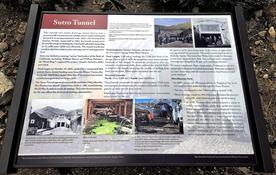
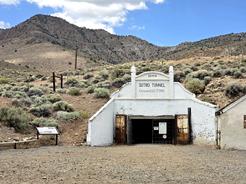
The concept of a water-drainage tunnel driven into a mountainside was not new, but Adolph Sutro’s vision and tenacity elevated it to an unprecedented scale. After a fire destroyed his Dayton, Nevada, stamp mill in 1863, the Jewish entrepreneur devoted his energy to draining the Comstock Lode and transporting ore to mills more safely and efficiently. The tunnel would also ventilate the lower mine levels, reducing stale air and oppressive heat. Sutro was hailed as a mining “savior,” but leaders of the Bank of California, including William Sharon and William Ralston, the “Bank Ring”- opposed the project. Despite obstacles, Sutro prevailed. Work began on October 19, 1869, marked by a ceremonial first pick by Sutro. Initial funding came from the Miners’ Union after the deadly 1869 Yellow Jacket Mine fire. If the tunnel had existed, it could have provided an escape route. The Sutro Tunnel operated successfully until 1942, when the War Production Board’s Limitation Order L-208, issued during World War II, halted nearly all mining. This order freed resources but devastated mining communities. Head Engineer: Herman Schussler, designer of San Francisco’s Spring Valley Water System. Total Length: 3.88 miles reaching the 1640-foot level of the Savage Mine on July 18, 1878. By completion, some mines extended hundreds of feet deeper. To accelerate construction after the invention of pneumatic drills, Sutro ordered five vertical shafts to intersect the tunnel, increasing the number of drilling faces from one to eleven. Three shafts succeeded; two did not. Necessary Laterals: North: Over 4,000 feet – South: over 8,000 feet These laterals connected 24 major producing mines. If all mines were pumped simultaneously, the tunnel could handle 3-4 million gallons of water per 24-hour period. Lives Lost: Twelve men died during construction - a remarkable safety record for the era. On April 2, 1879, amid rising waters in the mines, an agreement was signed with 24 operations. The mines loaned funds to Sutro to finish the laterals. The tunnel had 90 days to be ready for drainage. Loans were interest-free, with fees reduced until repayment. Drainage fees dropped to $1 per ton – shocking investors. To ensure compliance, Sutro constructed a bulkhead to seal the tunnel and to flood the Comstock if necessary. Work was completed on time. Sutro later sold the tunnel, moved to San Francisco, and never returned. Miscellaneous Facts . In 1889, storms cut off transportation to Virginia City; food and supplies were delivered through the Sutro Tunnel. . The last ore shipped to the 1900s mill around 1935. . Water drainage ceased in 1942 following President Roosevelt’s executive order banning precious metal mining. . In 1959, Senator Alan Bible, initiated a study to build a nuclear linear accelerator inside the tunnel; it was ultimately constructed at Stanford University. Houston Minerals explored reopening the tunnel in the late 1970s and built a water control dam, but abandoned the effort by 1980. Inspired by Sutro’s vision, restoration of the tunnel’s initial sections began in 2023 under Simerson Construction, rekindling public interest in one of the nineteenth century’s most important engineering achievements. Top two images: Left: This colorized image from Adolph Sutro’s 1874 lecture depicts workers at the tunnel portal before the façade was constructed. The hand-tinted glass slide was produced in London by Horne and Thornthwaite using the “Magic Lantern” technique. Photograph by unknown, 1874. Courtesy of Cliff Jennings and the Huntington Library. Right: A simple portal façade was added in 1888 to improve the tunnel’s appearance. Photograph by unknown, 1870’s, Courtesy of the Dan Webster Collection. Bottom three images, L-R: Portal façade constructed in 1888. Adjacent buildings formerly housed offices, later ice storage, and a “candle house” that supplied candles, lanterns, mule equipment and black powder used during tunnel construction. Before Restoration. Photograph by Julie Michler, 2021. Courtesy of the Julie Michler Collection. In 2023, Simerson Construction reopened a major collapse using innovative safety methods and rebuilt the timber structure in keeping with Sutro’s original design. Shown here, the crew prepares to install the “Turtle,” a protective framework to serve as a safe working canopy during stabilization. Photograph dated 2023. Text by historians Dan Webster and Pat Neylan. Edited by Melody Hoover and FoST Director of Tourism, Stephen Snow. Sign donated by the Jewish American Society for Historic Preservation
Erected 2026 by Jewish American Society for Historic Preservation.
The Sutro Tunnel
The Mill
The Mill
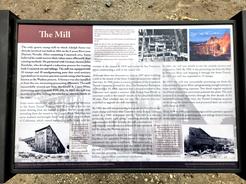
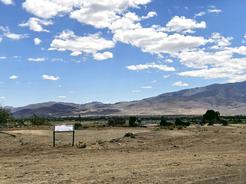
From 1938 to 1941, Jack Greenhalgh and his partners operated the Comstock mill, processing ore and tailings from Comstock mines with considerable success. Images – Clockwise beginning left-hand corner: There was a trestle to the north of the mill, directly opposite the tunnel, with track for ore cars, as seen in this photograph. The ore was dumped through a screen, and large rocks were crushed by a jaw crusher, then fed to the stamps. The mill was named The Comstock Ore Reduction Mill, or Comstock Mill. Photographer unknown, circa early Left: Inside view of the mill showing the stamps, which could press 10 tons of ore in 24 hours. Pelton water wheels provided the original motive power. Photograph shows the mill in disrepair. Photographer unknown, circa 1944. Courtesy Nevada Historical Society Right: On May 21, 1967, the mill caught fire about 7:00 p.m. It was thought that a tourist’s cigarette or an electrical short caused the fire. The mill was owned by Robin Larson, who had purchased it about five years earlier and planned to restore it. He fought the fire until about noon on May 22nd, but the mill was destroyed. Steel machinery
remained at the site until recently, when it was moved to the Sutro Tunnel site. Photographer unknown, circa 1967. Courtesy Pierce Powell Collection. This picture is looking west. An account by a boy who lived in the Mansion in the 1940s gave the following information about the mill: “There was a mill for processing ore directly from the tunnel portal. It was located down over the ore dump with a ramp just wide enough for a dump truck running out to the top story. I know it was a stamp mill as I used to slide down a chute under the blocked-up stamps. I remember we kids had a lot of fun playing in that old gold mill.” Photographer unknown, circa 1940. Courtesy Nevada Historical Society Text by historians Dan Webster and Pat Neylan. Edited by Melody Hoover and FoST Director of Tourism, Stephen Snow.
Sign donated by the Jewish American Society for Historic Preservation
The Mill
The Mule Barn
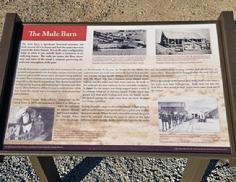
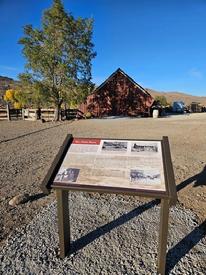
The mule barn, a significant historical structure, was built around 1874 to house and feed the mules that were used at the Sutro Tunnel. It is in the same configuration today as when it was initially built, a testament to its enduring legacy. The stalls are intact, the floor shows wear and most of the wood is original, preserving the authentic atmosphere of the past.
Initially, horses were employed, but their tendency to be easily spooked and panicked in the dim light, unexpected noises, and enclosed spaces of the tunnel led to their replacement by mules. These creatures, as strong as horses, proved to be more adaptable to the tunnel surroundings. They demonstrated their intelligence by learning and responding to blasting and other signals. Their instinctive ability to move to a safe distance when they heard the signals was a testament to their adaptability and resilience.
German-born, George Rammelkamp immigrated to the United States in 1859 and migrated to Silver City, Nevada in 1869. He relocated to Dayton, Nevada, and started working for Adolph Sutro in 1870. In charge of the livestock, he became the hostler for the mules. For eighteen years he made sure each mule had the best possible care and was the best hostler Adolph ever had. George, along with Mr. Bluett, a foreman, wrote Adolph letters making sure the mules had food, water, and ice. As many as two mules per day were overcome by the miserable conditions. A danger for the miners was being trapped under a mule if it suddenly collapsed. A favorite, named “Paddy”, went into spasms and died while hauling rock from the tunnel. Inside the tunnel, getting the mules away from the fresh air pipes was always a problem.
To help the mules adapt to the sudden change in light going in and out of the tunnel, one eye would have a patch over it outside. When the mule entered the tunnel, the patch would be removed, allowing the mule to adjust to the light difference more quickly. In the tunnel, the light for the mules was accomplished by hanging torches and oil lanterns to their collars. These would be changed when the mule left and reentered the tunnel.
When the laterals of the tunnel were being built to the mines, the mules were kept underground. Stalls were cut into the rock where they would be kept; some never came back out of the tunnel.
Erected 2025 by Jewish American Society for Historic Preservation.
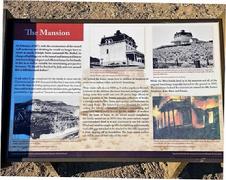
In February of 1872, with the construction of the tunnel well underway and thinking he would no longer have to travel as much, Adolph Sutro contacted Mr. Bethel, in charge of buildings etc at the tunnel and instructed him to construct a large, elegant and efficient house for his family to live in as well as suitable for entertaining prospective investors. “It should be finished by July and cost around $15 to $20 thousand dollars”.
A tall order. It was completed for the family to move into by Christmas and cost $40 thousand dollars but it was state of the art for the time including spring water piped from the tunnel that could be heated with coils in the kitchen stove, gas lighting provided by a “gas machine” located in a small building on the hill behind the house, steam heat in addition to fireplaces in every room, indoor toilets and lavish furnishings.
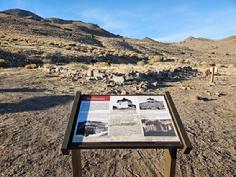
Three stories tall, close to 5000 sq. ft with a cupola on the roof, a favorite of the children, the house boasted an elegant parlor, dining room that could seat over 20 guests, large library to house a portion of Mr. Sutro’s extensive collection of books, a sewing room for Mrs. Sutro with parlors and bedrooms on the upper floors. The finished mansion provided the perfect setting for family celebrations, business entertaining and even Leah Sutro’s music lessons for the children of workers from the town of Sutro. As the tunnel neared completion, the family moved out in 1879. Over the years various tunnel superintendents lived in it and sometimes it was left vacant. Wind and weather caught up with the building and eventually steel cable guy wires had to be attached to two sides to prevent it from slipping off its foundation. The large round anchors can still be seen on two sides of the ruin. While the West family lived in it, the mansion and all of the original furnishings tragically burned to the ground in 1941.
The mountains behind the mansion are named for Mr.Sutro’s daughters, Kate, Rose and Emma.
Erected 2025 by Jewish American Society for Historic Preservation.